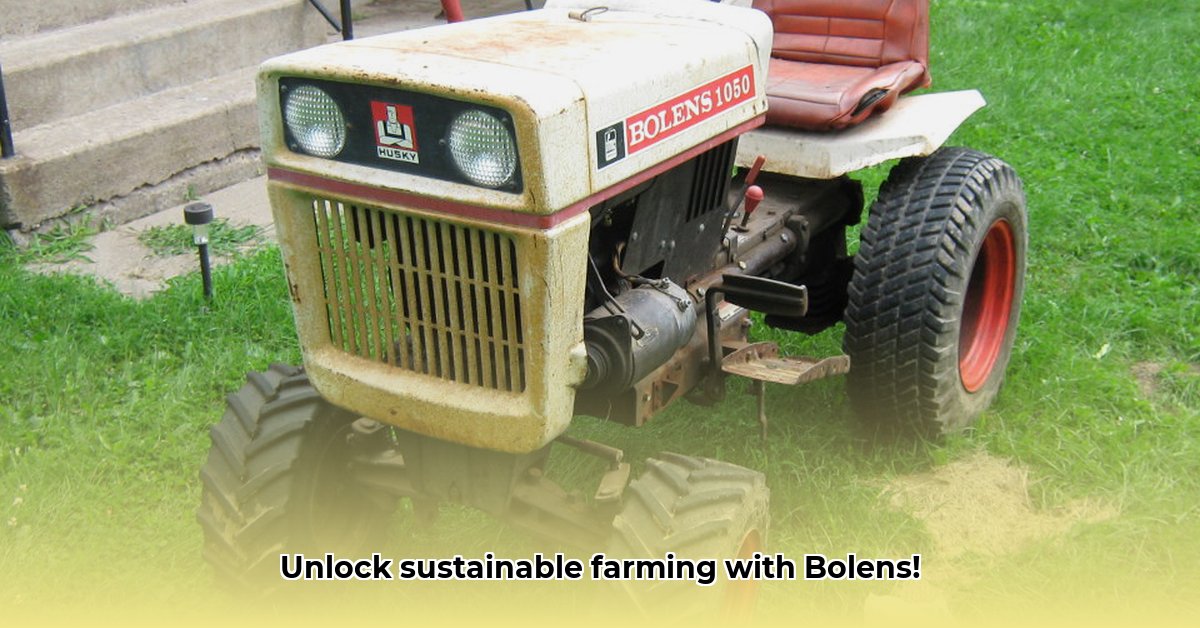
A Legacy of Innovation: Bolens and the Quest for Sustainable Agriculture
Ever considered a vintage garden tractor as a key player in sustainable farming? The Bolens garden tractor, a name synonymous with rugged dependability, might just hold the answer. This isn't simply a nostalgic look back; it's an exploration of the surprising relevance of Bolens tractors in the modern context of environmentally conscious agriculture. We'll delve into their history, highlighting key design features that align remarkably well with sustainable practices, while acknowledging the need for further research to fully understand their environmental impact. For comparison with modern compact tractors, see this resource.
From Humble Beginnings to Versatile Workhorses
The Bolens story begins in 1919, a time when agricultural labor was predominantly manual. Bolens' early tractors represented a significant leap forward, though far simpler than today's sophisticated machines. These early models were the foundational building blocks of a legacy forged in practicality and innovation, reflecting the ongoing human drive towards greater agricultural efficiency. Decades of evolution transformed them into versatile machines capable of a wide array of tasks. This progression mirrors the broader shift in agriculture, from human-powered methods towards increasingly mechanized ones.
Adaptability: The Bolens Advantage
One of Bolens' most significant contributions is the adaptability of its tractors. Models like the Husky 850, 1050, and 1250, weren't merely tractors; they were multi-purpose platforms. A simple attachment change transformed them from tillers to mowers to haulers. This inherent versatility is perfectly suited to the needs of modern sustainable farming practices. Consider small-scale, diversified operations employing permaculture or agroforestry techniques – the Bolens' adaptable nature makes it ideal for the varied demands of these systems. Could your permaculture project benefit from such a versatile, compact machine?
Untapped Potential: Bolens and Sustainable Farming Practices
The compact size of many Bolens tractors is a crucial element in their potential contribution to sustainable agriculture. Their maneuverability in tight spaces is particularly valuable in agroforestry systems or intensive farming methods that require precise control. This smaller footprint likely leads to reduced soil compaction compared to larger tractors, potentially minimizing soil damage and conserving its long-term health. But how truly sustainable are these older machines? We need more data to get definitive answers.
"While the smaller size and versatility of Bolens tractors suggest efficiency, comprehensive data on their precise fuel efficiency and long-term effects on soil health is lacking. This is an area ripe for further investigation," explains Dr. Emily Carter, Agricultural Engineering Professor at Cornell University.
Addressing the Challenges: Data Gaps and Future Directions
While the inherent qualities of older Bolens tractors suggest eco-friendliness, we lack sufficient data to make definitive claims about their overall sustainability. This is a critical area that needs immediate attention. A comprehensive understanding requires robust life-cycle assessments—evaluating fuel consumption, emissions over their complete lifespan, and their impact on soil structure.
"We need to move beyond anecdotal evidence and engage in rigorous life-cycle assessments to fully understand the environmental impact of these tractors," states Dr. Carter.
A Table Summarizing Potential Benefits, Drawbacks, and Research Needs
| Potential Benefit | Potential Drawback | Research Needed |
|---|---|---|
| Reduced soil compaction | Limited data on long-term soil health | Long-term studies on soil structure & biodiversity |
| Maneuverability in tight spaces | Potential lower power/efficiency | Comparative studies against modern, similar-sized equipment |
| Adaptability to diverse systems | Higher repair costs due to age | Cost-benefit analysis including parts and maintenance |
| Potential for biofuel conversion | Emissions profile with different fuels unclear | Emissions testing with various sustainable fuels |
Paving the Way Forward: Research, Innovation, and Collaboration
The potential of Bolens tractors in sustainable agriculture is real, but it remains largely untapped. To move forward, a multi-pronged approach is essential. Rigorous life-cycle assessments are paramount, alongside research into alternative fuels like biodiesel. Furthermore, manufacturers could play a crucial role by designing future models with sustainability as a core design principle. This means considering lighter materials, more efficient engines, and technologies to minimize soil compaction.
The Future of Bolens in Sustainable Agriculture: A Call to Action
The story of the Bolens garden tractor is one of both historical significance and promising future potential. While we lack comprehensive data on its full environmental impact, the inherent characteristics of these machines – their compact size, adaptability, and potential for biofuel conversion – all suggest a noteworthy role in a more sustainable agricultural landscape. However, realizing this potential requires a commitment to rigorous research, collaborative efforts between researchers, manufacturers, and farmers, and a forward-thinking approach to designing future models with sustainability at their heart. The future of sustainable agriculture may well depend on such innovative solutions.